

AI has transformed patent translation, promising drafts faster and cheaper than ever before. But for IP teams, speed alone isn’t enough — what matters is whether a translation is truly jurisdiction-ready: precise, legally sound, and fit for submission in a specific patent office with minimal attorney remediation.
To explore this, an independent company recently benchmarked Azami’s AI-powered Translation & Localization Engine (TLE) against the WIPO translation tool using a standardized Linguistic Quality Assessment (LQA). The results reveal a critical truth for IP professionals:
Not all AI translation is equally safe, especially when legal meaning matters more than surface fluency.
Why Patent Translation Is a Legal Risk, Not a Linguistic One
On the surface, machine translation has become impressively fluent. But patent translation isn’t just about fluency, it’s about preserving claim structure, technical meaning, and legal intent so the output can be relied on in prosecution and enforcement without introducing risk or delays, or introducing the kind of hidden sources of risk in global IP management that often only surface much later
Azami’s TLE is built for this. It’s a patent-aware, jurisdiction-ready AI engine trained on patent language and regulatory context, designed to respect patent formats, country conventions, and terminology right from the draft stage — reducing attorney edits and avoiding unnecessary office actions.
What “LQA” Really Measures in Patent Translation
Before we get to the benchmark results, it helps to understand what LQA is and why it matters.
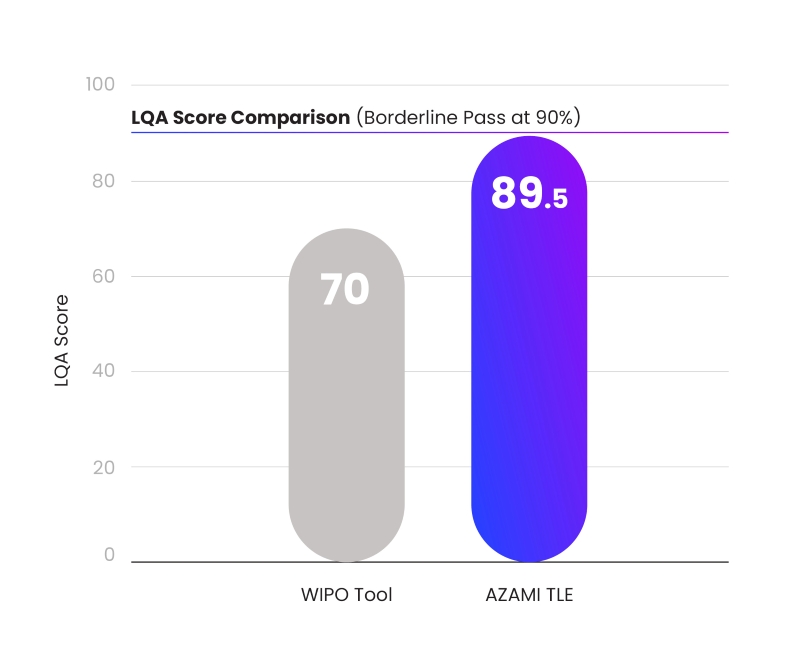
Linguistic Quality Assessment (LQA) isn’t a general language or fluency score. It’s a risk-focused evaluation that classifies translation errors by their legal and technical impact:
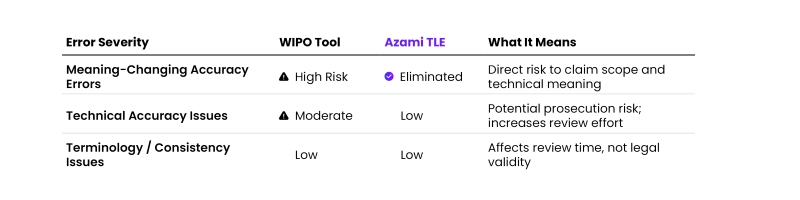
- Accuracy (High Risk) – Errors that change technical meaning or claim scope — highly damaging in patent work.
- Terminology (Medium Risk) – Inconsistent or incorrect use of technical terms — raises review effort and semantic ambiguity.
- Consistency / Polish (Low Risk) – Minor phrasing issues that affect review time but not legal validity.
LQA therefore measures whether a translation is fit for legal review and filing, not just whether the text “sounds good.” That’s why we benchmarked using LQA, not generic AI scores, because in IP, legal meaning matters more than surface fluency.
Benchmarking TLE vs. WIPO: A Closer Look at Legal Readiness
In the independent benchmark:
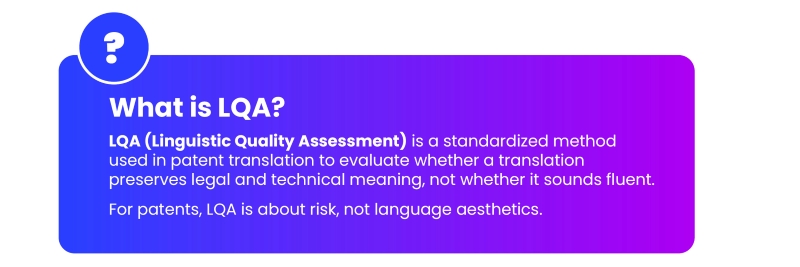
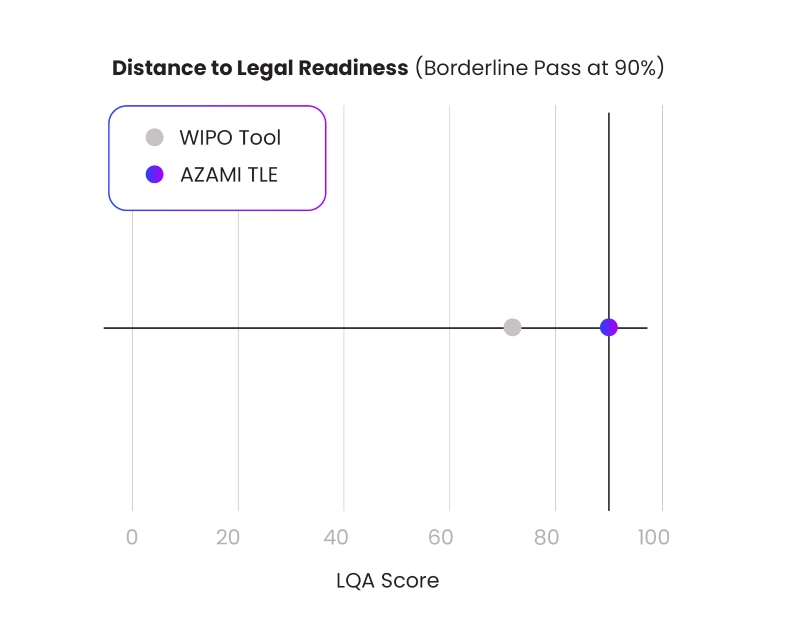
- TLE’s LQA score came close to the 90% “borderline pass” threshold indicating a translation that can quickly be made filing-ready with minimal attorney edits.
- The WIPO translation scored substantially lower, falling far short of the threshold.
At first glance, both tools were below the 90% boundary. But the real story lies in what those scores mean in practice.
Risk Profiles Tell the True Story
WIPO Tool:
Still produces meaning-changing accuracy errors including translation mistakes that can alter claim scope, technical function, or legal intent. These are high-risk issues that slow review, increase rework, or introduce filing risk.
Azami TLE:
Eliminates all meaning-changing accuracy errors in the benchmark. What remains are terminology or consistency issues which are low-risk items that mostly impact review time, not legal validity.
This distinction is crucial: one tool still carries claim-impacting errors, while the other produces drafts that are close to filing-ready, precisely the outcome IP teams care about. The difference isn’t just numbers. It’s risk and cost of legal work.
“Distance to Pass”: A Risk-Based Insight
Another way to see this difference is through the distance to the pass threshold:
- TLE: ~0.5 points below the 90% borderline pass — remediable with light legal review.
- WIPO: About 20 points below — a structural gap requiring substantive correction.
Put simply:
- TLE drafts can move toward filing readiness with minor edits.
- Generic translation remains far from that stage, pulling valuable attorney time and introducing risk.
This is consistent with TLE’s design goal: deliver jurisdiction-ready drafts that reduce attorney edits and keep filings moving.
What This Means for IP Professionals
Here’s the practical takeaway for in-house IP teams and law firm partners:
- Translation tools aren’t interchangeable. A high-level AI output can sound good but still hide legal risk.
- Jurisdiction-ready outputs require patent-specific intelligence. Generic tools often misinterpret patent claim structure, terminology, or legal nuance.
- LQA is the right lens for evaluation. It shifts focus from fluency to legal survivability, aligning measurement with legal workflows.
Choosing a translation engine that understands patent language and filing nuance, like TLE, can reduce rework, cut office action exposure, and speed filings without sacrificing quality.
A Different Standard for AI in IP
The benchmark underscores a deeper shift in how AI should be evaluated in patent workflows:
Not “Is it fast?” but “Does it lower risk without excessive attorney correction?”
Azami’s TLE was designed with this philosophy. It’s not just another AI translation engine, it’s a jurisdiction-ready, patent-aware system that produces structured drafts you can trust to move toward filing with confidence.


