


(Definition, Risks, and Requirements)
When patent professionals talk about translation quality, they’re rarely talking about grammar alone.
They’re talking about whether a translated patent can actually be filed, examined, and relied on in a specific jurisdiction without introducing risk, delay, or costly rework.
That difference between a translated document and a jurisdiction-ready patent translation is where many global filings quietly break down.
In this article, we define what jurisdiction-ready really means in patent translation, explain why standard approaches often fall short, and outline the practical requirements IP teams must account for when filing patents across borders.
What Does “Jurisdiction-Ready” Mean in Patent Translation?
A jurisdiction-ready patent translation is not just linguistically accurate. It is a translation that is fit for submission, examination, and legal reliance in a specific patent office.
In patent practice, a jurisdiction-ready translation is one that meets the legal, linguistic, and procedural requirements of the target patent office without requiring substantive post-translation correction, including compliance with formal language and translation requirements set out under the Patent Cooperation Treaty (PCT)
In practice, that means the translation must:
- Conform to local legal and technical standards
- Preserve claim scope and legal intent
- Align with jurisdiction-specific terminology and conventions
- Minimize the need for post-translation attorney correction
A jurisdiction-ready translation can move directly into a filing or validation workflow without becoming a bottleneck — an increasingly important requirement in global patent practice.
Why Standard Patent Translations Often Fall Short
Most patent translation failures don’t happen because translators misunderstand the source language. They happen because translation is treated as a linguistic task instead of a jurisdictional one. Here are the most common breakdowns.
1. Literal Accuracy Without Legal Precision
A translation can be grammatically correct and still be legally risky. Patent claims depend on:
- Defined terms
- Precise phrasing
- Jurisdiction-specific legal interpretation
Overly literal translations can:
- Narrow or unintentionally broaden claim scope
- Break internal consistency between claims
- Introduce ambiguity during examination
These issues often surface only after filing when fixes are expensive or impossible.
2. Ignoring Jurisdiction-Specific Patent Practice
Each patent office has its own expectations around:
- Claim structure
- Terminology preferences
- Drafting conventions
- Disclosure style
For example:
- European patent examination places heavy emphasis on clarity and consistency
- Some jurisdictions scrutinize functional claim language more aggressively
- Others require stricter alignment between claims and description
Generic patent translation services rarely adapt translations to these realities.
3. Lack of Technical Context
Patents are technical instruments, not just legal documents. Without sufficient technical context:
- Key terms may be translated inconsistently
- Industry-standard phrasing may be lost
- Examiner expectations may not be met
This risk increases in complex fields such as biotechnology, software, and advanced engineering.
4. Fragmented Translation Workflows
Traditional workflows often involve:
- External translators
- Email-based revisions
- Manual quality checks
- Disconnected filing systems
This fragmentation increases the likelihood of:
- Version control errors
- Terminology drift
- Missed deadlines during critical filing windows
Jurisdiction readiness requires process discipline, not just language skill.
The Core Components of a Jurisdiction-Ready Patent Translation
A jurisdiction-ready patent translation typically includes the following core components.
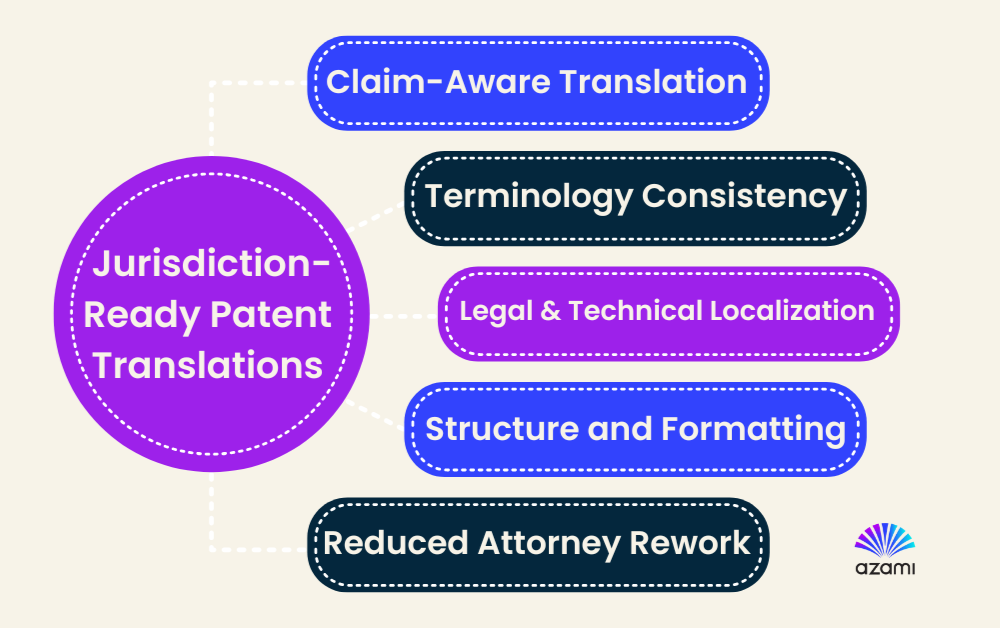
1. Claim-Aware Translation
Claims are the legal foundation of a patent.
A jurisdiction-ready translation must:
- Preserve claim hierarchy and dependencies
- Maintain consistent terminology across all claims
- Respect jurisdiction-specific claim interpretation norms
This requires translation approaches — human or AI-assisted — that understand claim logic, not just sentence structure.
2. Terminology Consistency Across the Entire Document
Inconsistent terminology is a frequent cause of examiner objections.
Jurisdiction-ready translations ensure that:
- Defined terms remain consistent throughout
- Technical phrases are translated uniformly
- References align with local patent practice
This is difficult to achieve with manual workflows alone, especially at scale.
3. Localized Legal and Technical Language
Localization goes beyond translation.
It accounts for:
- How examiners expect technical concepts to be expressed
- Accepted equivalents in the local patent ecosystem
- Jurisdiction-specific legal phrasing
This is where patent localization becomes just as important as translation itself.
4. Structural and Formatting Readiness
Even accurate translations can be delayed or rejected if they:
- Fail to meet formal submission requirements
- Misalign document structure
- Require reformatting before filing
Jurisdiction readiness anticipates these constraints from the start.
5. Reduced Attorney Rework
One of the clearest indicators of jurisdiction readiness is how much correction is required after translation.
High-quality translations:
- Reduce revision cycles
- Minimize attorney intervention
- Accelerate time-to-file
When translations align with jurisdictional expectations from the outset, fewer corrective cycles are needed, reducing both legal risk and time to file.
Where AI Fits — and Where It Requires Oversight
AI has meaningfully improved what’s possible in patent translation — when applied correctly.
AI-assisted systems excel at:
- Maintaining terminology consistency
- Applying structured rules across long documents
- Supporting repeatable, jurisdiction-aware workflows
- Accelerating turnaround times
However, legal judgment and strategic review still matter.
The most effective modern workflows combine AI-powered patent translation and localization with IP-aware controls and expert oversight.
Why Jurisdiction-Ready Translations Matter More Than Ever
Global patent activity continues to grow while IP teams at law firms and corporate IP departments face tighter deadlines, resource constraints, and increasing portfolio complexity:
- Tighter deadlines
- Resource constraints
- Increasing portfolio complexity
In this environment, translation errors introduce more than inconvenience, they introduce strategic risk.
Jurisdiction-ready patent translations help teams:
- File faster with greater confidence
- Reduce downstream corrections
- Preserve claim integrity across jurisdictions
- Scale global filings without scaling operational friction
Final Thought: Jurisdiction-Ready Is a Standard, Not a Feature
The right question is no longer:
“Is this translation accurate?”
But:
“Can this translation be filed, examined, and relied on — as is — in this jurisdiction?”
That distinction separates translation as a task from translation as a strategic capability.
If your organization is reassessing how it approaches global filings, understanding what jurisdiction-ready truly means is a critical first step.
Frequently Asked Questions
What is a jurisdiction-ready patent translation?
A jurisdiction-ready patent translation is one that meets the legal, linguistic, and procedural requirements of a specific patent office and can be filed without substantive correction.
Why do patent translations get rejected or delayed?
Most delays occur when translations fail to align with jurisdiction-specific claim language, terminology, or formatting expectations.
Is AI reliable for patent translation?
AI can significantly improve consistency and speed when used within an IP-aware workflow, but legal oversight remains essential.


