


Global intellectual property work has never been more complex or more scrutinized.
IP teams are expected to move faster, control costs, manage risk, and explain decisions to leadership with confidence. Yet many of the most important choices in global IP management are still made with incomplete, fragmented, or anecdotal information.
This isn’t just an operational inefficiency.
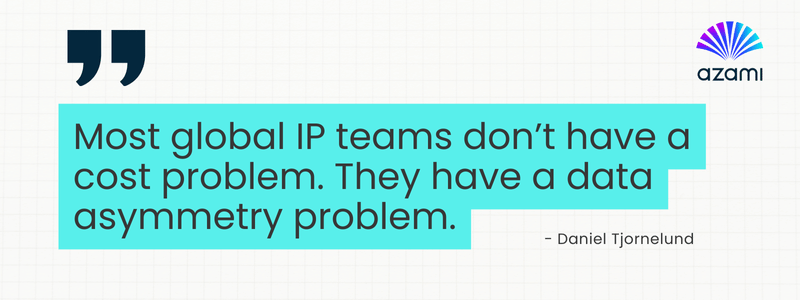
It’s a data asymmetry problem and it sits at the root of many of the cost, quality, and risk issues that global IP teams face today.
What Is Data Asymmetry in Global IP Management?
Data asymmetry occurs when decision-makers do not have access to the same quality, structure, or visibility of information as the parties executing the work — or when critical data exists, but cannot be compared, analyzed, or acted on in time.
In global IP management, data is often:
- Dispersed across jurisdictions
- Held by external partners
- Stored in emails, spreadsheets, or legacy systems
- Known informally, but not measured objectively
As a result, IP leaders are asked to justify strategy, spend, and performance without having a complete or connected view of the underlying data.
This is why many organizations are moving toward a system-based approach to global IP management. One that centralizes information, creates comparability, and supports decisions with evidence rather than anecdotes.
How Data Asymmetry Creates Risk Across Global IP Operations
Data asymmetry is not theoretical. It creates real, recurring risk across the IP lifecycle.
1. Foreign Agent Selection Based on Anecdotes
Choosing foreign agents is one of the most consequential decisions in global IP — yet it is often driven by:
- Historical relationships
- Individual experiences
- Informal recommendations
Without structured, comparable data, firms struggle to objectively evaluate:
- Quality of work
- Responsiveness
- Jurisdiction-specific expertise
- Cost relative to outcomes
What feels like trust is often habit — and habit is difficult to defend when questions arise. Without structured data, firms have no objective way to compare agent quality, responsiveness, or outcomes across jurisdictions making it difficult to manage a global network strategically.
2. Quotes That Are Slow, Inconsistent, and Hard to Defend
Global IP quoting frequently involves:
- Manual outreach to multiple agents
- Inconsistent fee structures
- FX uncertainty
- Local rules embedded in email threads
By the time a quote is delivered, it is often difficult to explain why it costs what it does — especially to clients or internal stakeholders demanding transparency and predictability. Without clean, structured cost data, even experienced teams struggle to deliver foreign filing and patent filing quotes that are fast, consistent, and defensible.
The issue isn’t pricing alone. It’s the absence of structured, reusable cost data.
3. Reciprocity That Is Invisible and Hard to Balance
Reciprocity underpins many global IP networks, yet it is rarely measured with precision.
Without clear data, firms lack visibility into:
- Work sent versus work received
- Jurisdiction-level imbalances
- Whether reciprocity aligns with quality and performance
This turns network management into a reactive exercise, rather than a strategic one.
4. Translation and Localization Bottlenecks
Patent and trademark translations frequently slow filings and prosecution because:
- Vendors lack jurisdiction-specific IP context
- Localization decisions happen too late in the process
- Attorneys are forced to rewrite, not review
The underlying challenge is not translation quality alone. It is missing, unstructured IP data at the start of the workflow. When patent translation and localization workflows are informed by structured IP data and jurisdiction-specific rules from the start, localization becomes faster, more accurate, and far less disruptive.
5. Renewals Managed Manually, With Hidden Risk
Despite their importance, renewals are still often handled through:
- Spreadsheets
- Email reminders
- Manual deadline tracking
When rules, deadlines, and fees are not centralized and validated, risk increases — even for experienced teams with strong processes.
Why Traditional Fixes Don’t Solve the Problem
To cope with growing complexity, many organizations respond by:
- Outsourcing more work
- Adding additional vendors
- Hiring more administrative staff
- Building increasingly complex spreadsheets
These approaches may reduce short-term pressure, but they do not resolve data asymmetry.
Without a connected system:
- Outsourcing introduces opacity
- More vendors fragment information further
- Manual processes fail to scale
- Institutional knowledge remains locked in individuals
The underlying imbalance persists.
Why Global IP Management Requires Systems, Not Transactions
Solving data asymmetry requires a shift away from isolated transactions toward system-level thinking.
A system-based approach to global IP:
- Centralizes internal and external IP data
- Structures rules, costs, and deadlines
- Creates comparable performance signals
- Supports decisions with evidence, not anecdotes
When data is structured and connected:
- Agent selection becomes defensible
- Costs become predictable
- Quality becomes measurable
- Risk becomes manageable
Why Azami Built iPeer OS as a System
Data asymmetry is not a new problem but its impact has grown as global IP portfolios expand and expectations increase.
This is why Azami positioned iPeer OS as a system, not a collection of point solutions.
iPeer OS is designed to organize the data that global IP teams already rely on including rules, costs, partner performance, translation inputs, and renewal information, and make it structured, connected, and usable across the entire IP lifecycle.
The goal is not to replace relationships. It is to support them with clarity, visibility, and evidence.
Turning Visibility Into Advantage
As global IP work becomes more complex, the gap between teams with structured data and those without will continue to widen.
The question is no longer whether data asymmetry exists. It is whether your IP operation is built to overcome it.


